https://sites.google.com/site/wikimyeducation/
Sunday, October 28, 2012
Action Research Plan Update
This weeks assignment provided me an opportunity to reflect on my research and begin the process of reporting the results. The project will utilize data over a 3 year period, starting in May 2010 and concluding in May 2013. The draft of my Action Research Report an be found on my wiki page, Wiki My Education.
https://sites.google.com/site/wikimyeducation/
https://sites.google.com/site/wikimyeducation/


Sunday, August 19, 2012
Reflections from Digital Media EDLD 5366
Our team created a collaborative website using C.R.A.P. design concepts.
It can be viewed from this link. Team Digital Techs
It can be viewed from this link. Team Digital Techs
This course
introduced new terminology to me. The concepts were not new; I have been using design
concepts in my current position as a Career and Technical Education program
manager. In addition, I utilized design
principles in my past position as a classroom teacher (photo-journalism, web
development, yearbook sponsor, computer applications and graphic design). I took classes in college, taught design practices
in the classroom, and utilized it in my personal business. However, I have never heard it referred to as
C.R.A.P. I found this acronym very
amusing and will use it often with my co-workers and when mentoring teachers
that need some help with the concept.
One of our
assigned readings for this course was “How crap is your site design?” by M. Rundle. I really enjoyed this author’s personality as
it came through his writings. “We learned that good design is based on the C.R.A.P. principles where C.R.A.P. stands for Contrast Repetition Alignment
Proximity, and when Creative Directors tell you that your design is crap,
they’re actually giving you positive reinforcement.” I
think students and teachers will enjoy this play on words. I could envision
this word as a ‘hook’ to gain the
interest of hard to reach high school students. A note of caution, some may
take offense or misunderstand the acronym.
The explanation should appear simultaneously when using it as a catchy
title of an assignment.
For some,
the concept seems to be intuitive and the efficient placement of information on
a flyer, web page or other graphic project is easy.
For others, the end product appears to be result of the lack of planning.
Their design has too much information and it is difficult to determine interest. Many times poorly designed web pages or
flyers will cause viewers to “move on” because there is too much information to
determine its value. Another possible outcome of no C.R.A.P., the viewer may
have interest, but limited time, or attention span, to find the important
information. Educators teaching or using
graphic design can easily remember the C.R.A.P. acronym and put the technique
to good use when utilizing or teaching the basic design concepts. (I would add
that using C.R.A.P. concepts would be helpful in some email correspondence.)
Wiki pages or other web based pages can be used for distance learning or blended learning environments. Teachers post their assignments on their web page. Students that are absent can see new assignments, read announcements and comment or ask questions. This could also be used in an extended absence situation where a student is prevented from attending classes for medical or behavior problems. Teacher's web pages are an excellent communication tool for parents, homework is clearly stated and assignment due dates are posted. Parents can keep tabs on their students’ homework and due dates, on demand, anytime of day or night. In addition, classes can collaborate with students within the district or around the country. Their work can be posted for feedback and brainstorming ideas for projects and problem solving.
Wiki pages or other web based pages can be used for distance learning or blended learning environments. Teachers post their assignments on their web page. Students that are absent can see new assignments, read announcements and comment or ask questions. This could also be used in an extended absence situation where a student is prevented from attending classes for medical or behavior problems. Teacher's web pages are an excellent communication tool for parents, homework is clearly stated and assignment due dates are posted. Parents can keep tabs on their students’ homework and due dates, on demand, anytime of day or night. In addition, classes can collaborate with students within the district or around the country. Their work can be posted for feedback and brainstorming ideas for projects and problem solving.
Another useful
tool when designing a class website project, or any classroom activity, is
reflection and feedback. We should step
away from the project and look at the page with a fresh outlook and self
reflect. Or ask a colleague to review and be open to an honest critique. In an article, Feedback that fits, S. Brookhart offered some wise advice, “To
craft teacher feedback that leads to learning, put yourself in the student's
shoes.” She expanded the comment by saying, “But feedback is only effective
when it translates into a clear, positive message that students can hear.”
Reflection
and feedback can also be used by students in the classroom to analysis their
own learning. Educators can begin at an
early age introducing the concept of reflection and feedback in the elementary
classes. The “Think, Pair, Share”
activity is good for every age of learner, from kindergarten to career
professionals. Educational leaders and teachers
use reflection as a tool for planning, staffing decisions, scheduling, discipline;
every activity of their school day or event.
By reflecting on the past or planning for a future event, we can avoid many
conflicts and crisis. Educators can
teach elementary age students to use reflection with simple open ended questioning
techniques and graduate to the pairing and sharing, as they begin to master
self reflection.
On a website, “Exploring the Environment”, T.
Herbert was quoted as saying, “The teacher must also be able to vary his or her
approach in helping the students analyze what has taken place. The methods are
dependent on the personalities and situations involved.”
Every
learning environment has its unique situations, depending on the learners and
participants. A good educational leader takes
time to know their audience and tailor self reflection and feedback activities
to foster a safe learning environment.
This was evident to me as I worked with my classmates on our website for
this class. I was forced from my control
comfort zone and into a collaborative environment. I was fortunate in that I had team members
that created that safe environment to express conflicting ideas and move to a consensus
in a non threatening manner.
Occasionally, we have to work on a projects where we may not feel safe. This is not conducive to a collaborative
project because it causes some to have too much input and some to have too
little.
As an
example, I would like to tell a personal experience. I recently participated in
training where a group of 20 district leaders (administrators and curriculum specialist)
were in asked to participate in a desert plane crash situation. Everyone with any information, as to location,
died in the crash. We were given a list
of items that were salvaged from the plane. As a group, we had to decide our
course of action, what to use and how to use it. In addition, we were to rank the items in order
of importance. Trained observers were in
the room taking notes on our problem solving techniques.
I had some experience
in survival training, as my son was an Eagle Scout and he (with my help) earned
the survival badge. After a few of my suggestions
were shot down by an aggressive principal, I stopped making suggestions. After the
all groups made their rescue plans, we reconvened as a large group (5 plane
crashes) to compare our plans to those of an expert on desert survival. The outcome of these group collaborations was interesting.
Let me say, most of the plane crash
survivors, did not survive their rescue plans. (A word of warning, when lost in the desert,
facing dehydration, if someone tells you to take salt tablets and you obey, you
will die before being rescued.)
The results
of the impartial observer, showed many of the rules of collaboration were
broken; some with good ideas were never heard, and those with bad ideas, but
were outspoken, lead the group into disaster.
I liked the activity and will use it in the future when conducting
collaboration training, with students or adults.
The skills
we acquired or improved during the course of this class will improve my
effectiveness as an educational leader.
As I reflect on the events, I have learned the importance of listening
more and talking less, as well as, being open to other viewpoints. It is
important to recognize that everyone has a voice in the decision and the
outcome, even if you agree to disagree, it’s important to find the middle
ground. It is important for us to
remember the one important factor in all our efforts; it’s not about the teacher,
it’s about the students.
Rundle, M, How C.R.A.P is Your Site Design?,
April 2006, retrieved from http://thinkvitamin.com/design/how-crap-is-your-site-design/
Brookhart, S. M., Feedback
that fits, (Dec 2007/Jan 2008), Volume 65, Number 4
Informative Assessment, Pages 54-59, retrieved from http://www.ascd.org/publications/educational-leadership/dec07/vol65/num04/Feedback-That-Fits.aspx
Informative Assessment, Pages 54-59, retrieved from http://www.ascd.org/publications/educational-leadership/dec07/vol65/num04/Feedback-That-Fits.aspx
Herbert, T., (1995), Experiential
learning: A teacher's perspective, retrieved from http://www.cotf.edu/ete/teacher/reflect.html
Sunday, August 12, 2012
TEAM DIGITAL TECHS
We have just completed week 4 of Digital Media 5366. This was another collaborative project that I participated as a team member with "Team Digital Techs".
The team members are
Tanya Henslee from Austin,
Ericka Turner from Beaumont,
Randy Clements from Killeen
Mary Angel from Austin.
You can view our web sites by following the link to TEAM DIGITAL TECHS.
Friday, August 3, 2012
Digital Graphics 5366 - Animation Project Week 3
Digital Graphics 5366
See my silly animation on You Tube!
http://www.youtube.com/watch?v=yIeaO5GW-2E&feature=youtu.be
See my silly animation on You Tube!
http://www.youtube.com/watch?v=yIeaO5GW-2E&feature=youtu.be
Saturday, July 21, 2012
Evidence of the use of Design Principles in ancient manuscripts
“Bible from Ethiopia, Commissioned by
Emperor Iyasu in around 1700.
By examining the ancient works of authors
in the 1700, one can see that they recognized and followed many of the same
principles of design that we observe today in modern digital graphics. The manuscript used to demonstrate these
similarities is, “Bible from Ethiopia, Commissioned by
Emperor Iyasu in around 1700.
By viewing pages 2 and 3,
one will notice the use of an illustration on the left page and some writing on
the right page. The writing is in
Hebrew, however, some of the text is in red ink and some is in black. If we compare to our modern day bible, we can
assume the red text is important and is set out from the majority of the other
words. This demonstrates the use of the
first design principle, Contrast.
As we look at these pages
and following pages, you will see that Repetition is demonstrated in the use of
images to illustrate acts, and the use of graphics to surround the text on the
following pages. These graphics are
different, but share repeated designs using columns, leaves, trees, birds and arches.
Alignment is shown by
keeping the text evenly spread between the “cells” of the graphics containing
text. No indention or spacing is used in
the text.

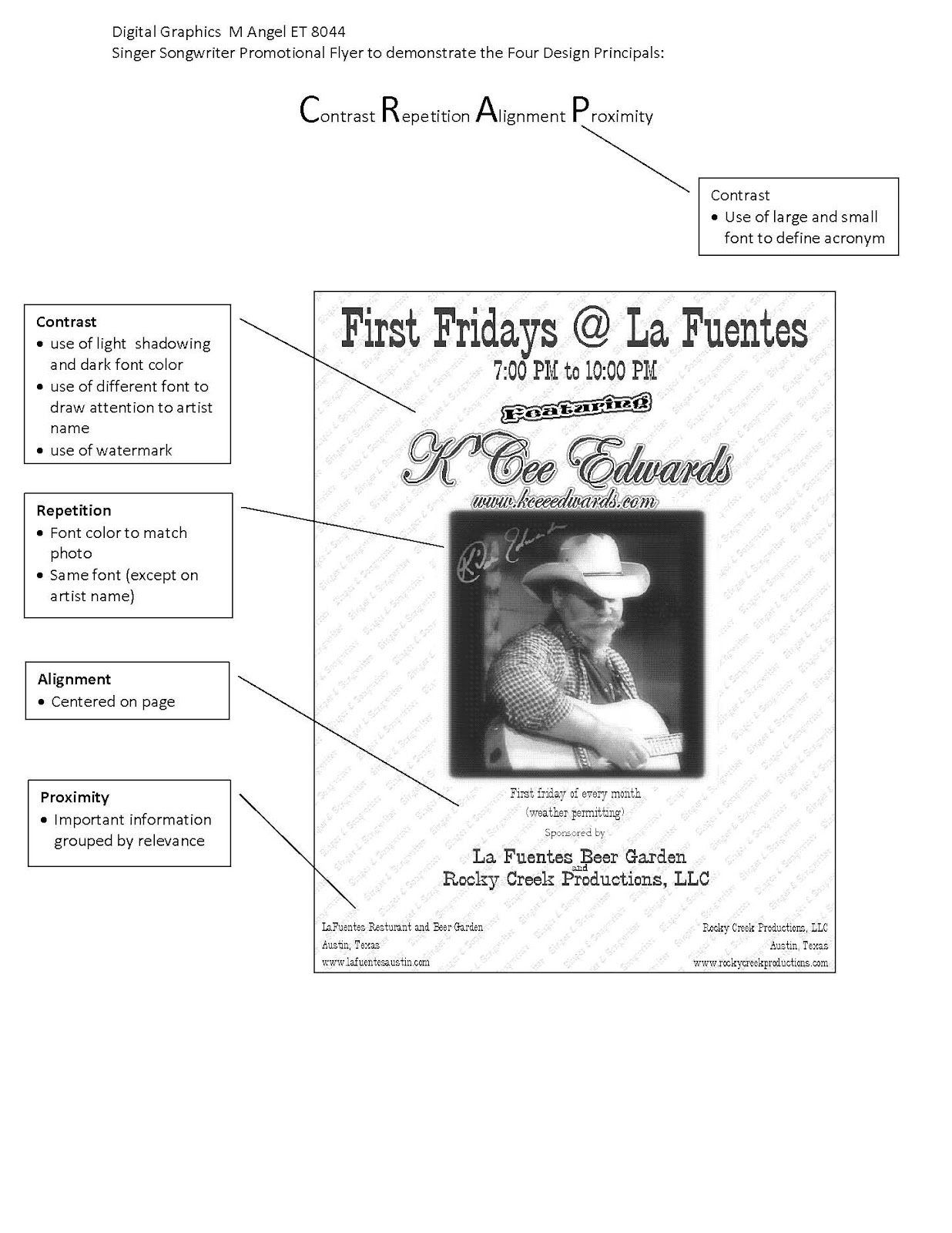
Digital Graphic 5366 - Four Design Principles teaching tool
This document can be used to teach or demonstrate the design principle in a classroom.

Friday, July 6, 2012
Action Research Plan - update as of July 6, 2012
I re-posted my original Action Research Plan from March 17, 2012 so the updates would be more meaningful to readers.
In our Course EDLD 5301 we were asked to formulate an Action Research project and work on it throughout our internship. Periodically, other classes ask that we report on our progress and document the work being done and what impact our plan may have on our campus or in our district.
I am very happy with the outcome of my work on district committees to improve the 8th grade Technology Proficiency in Austin ISD. When I began my research, I discovered that less than half of all 8th grade students passed the proficiency test adopted by our district. While looking for an explanation for these dismal results, I discovered that only about 60% of students even took the exam.
The details are included in my Action Research document, however, I will outline the work briefly.
Questions: What can the district do to increase the proficiency test scores of 8th grade students in AISD to meet the requirements of NCLB, the Texas Long Range Technology Plan, and AISD eRateTechnology Plan.
by 2013
Evidence 1.4.1 - 100% of 5th and 8th grade students take the online TLA in May. 70% of students will receive a "proficient" score.
Austin ISD has 19 middle schools.
May 2011 - Results
I contacted several members of our technology support team and found that most had no idea why we were testing 8th grade students. There was a large turnover of personal in that department and the lead person had left the district.
Once I provide key people with the actual details of our AISD tech plan, a committee was formed, I was invited to join, and we began meeting and formulating a plan for the 2012 testing period.
Our lead members from Instructional Technology, Josie Hughes and Deborah Rang led the charge by getting a document blessed by upper administration that was sent to all principals at the middle school campus. This document outlined the importance of the testing and that is was not an "optional" test.
Counselors had been using the "busy" test for low performing students.
The 2012 preliminary results are very favorable and I will be analyzing the data later this summer.
However, the good news is that :
More details to follow.
In our Course EDLD 5301 we were asked to formulate an Action Research project and work on it throughout our internship. Periodically, other classes ask that we report on our progress and document the work being done and what impact our plan may have on our campus or in our district.
I am very happy with the outcome of my work on district committees to improve the 8th grade Technology Proficiency in Austin ISD. When I began my research, I discovered that less than half of all 8th grade students passed the proficiency test adopted by our district. While looking for an explanation for these dismal results, I discovered that only about 60% of students even took the exam.
The details are included in my Action Research document, however, I will outline the work briefly.
Questions: What can the district do to increase the proficiency test scores of 8th grade students in AISD to meet the requirements of NCLB, the Texas Long Range Technology Plan, and AISD eRateTechnology Plan.
by 2013
Evidence 1.4.1 - 100% of 5th and 8th grade students take the online TLA in May. 70% of students will receive a "proficient" score.
Austin ISD has 19 middle schools.
May 2011 - Results
- approximately <60% of all 8th grade students were tested
- <50% were proficient
While dissecting the data, these questions were raised.
- Why did some campuses successfully test the majority of their students and some campuses tested none of their students?
- Why did some campuses only test 20- 50% of their students?
- Why did <50% of the tested students pass the proficiency test?
I contacted several members of our technology support team and found that most had no idea why we were testing 8th grade students. There was a large turnover of personal in that department and the lead person had left the district.
Once I provide key people with the actual details of our AISD tech plan, a committee was formed, I was invited to join, and we began meeting and formulating a plan for the 2012 testing period.
Our lead members from Instructional Technology, Josie Hughes and Deborah Rang led the charge by getting a document blessed by upper administration that was sent to all principals at the middle school campus. This document outlined the importance of the testing and that is was not an "optional" test.
Counselors had been using the "busy" test for low performing students.
The 2012 preliminary results are very favorable and I will be analyzing the data later this summer.
However, the good news is that :
- every campus administered the test
- almost 75% of all students were tested
I expect that our proficiency rate increased as well.
Our committee will begin meeting earlier next year to implement a plan to use 5th grade student results to determine electives choices for students entering middle school.
Recommendations from my Action Research Plan:
- that a technology rich CTE course be mandatory for students not demonstrating 5th grade proficiency.
- proficiency test administered in the fall and students not demonstrating proficiency be place in additional technology rich CTE course.
More details to follow.
Subscribe to:
Posts (Atom)